Olympiad Toolkit

A growing collection of essential formulas, identities, and techniques for mathematical olympiad problem solving.

Showing 151–156 of 156 toolkits
  1. 151.

    Mathematical induction proves statements for every integer in a specified range using a base case and an inductive step.

    Base Case

    P(n0)P(n_0)

    Inductive Step

    P(k)⟹P(k+1)P(k)\Longrightarrow P(k+1)

    Extensions include strong induction, step-size induction, binary induction, and Cauchy induction.
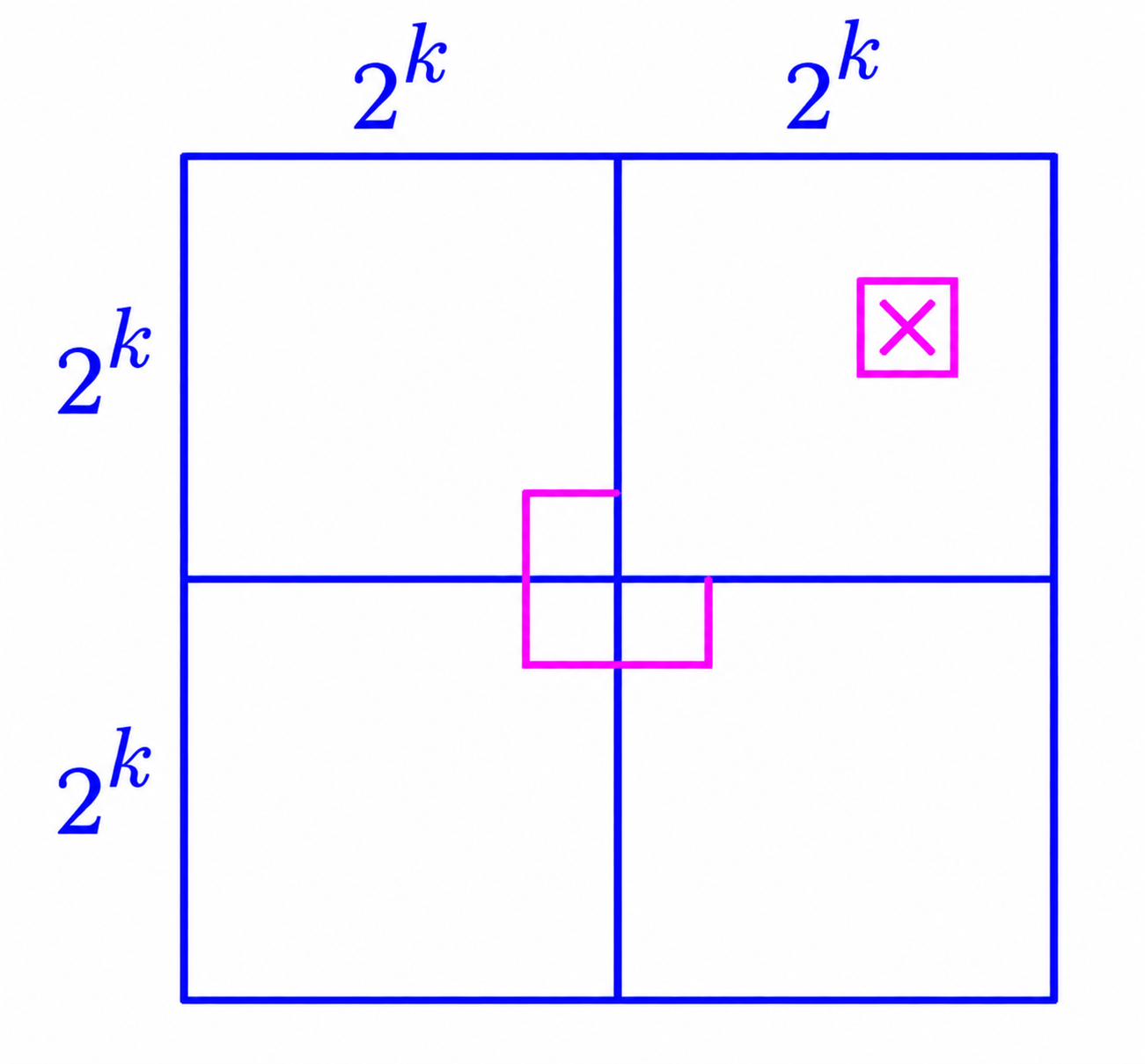
    Four quadrants with the original missing cell and a central L-shaped tromino (16.3.png)
  2. 152.

    The Fibonacci sequence starts with 0 and 1, and each subsequent term is the sum of the previous two.

    F0=0,F1=1,Fn+2=Fn+1+FnF_0=0,\quad F_1=1,\quad F_{n+2}=F_{n+1}+F_n
    0, 1, 1, 2, 3, 5, 8, 13, 21,…0,\ 1,\ 1,\ 2,\ 3,\ 5,\ 8,\ 13,\ 21,\ldots
    nn0011223344556677
    FnF_n001111223355881313
  3. 153.

    Every real square is nonnegative. This helps prove inequalities and find minimum values.

    x2≥0(x∈R)x^2\ge0\qquad(x\in\mathbb{R})
    a2+b2−2ab=(a−b)2≥0a^2+b^2-2ab=(a-b)^2\ge0
    x2−6x+13=(x−3)2+4≥4x^2-6x+13=(x-3)^2+4\ge4
  4. 154.
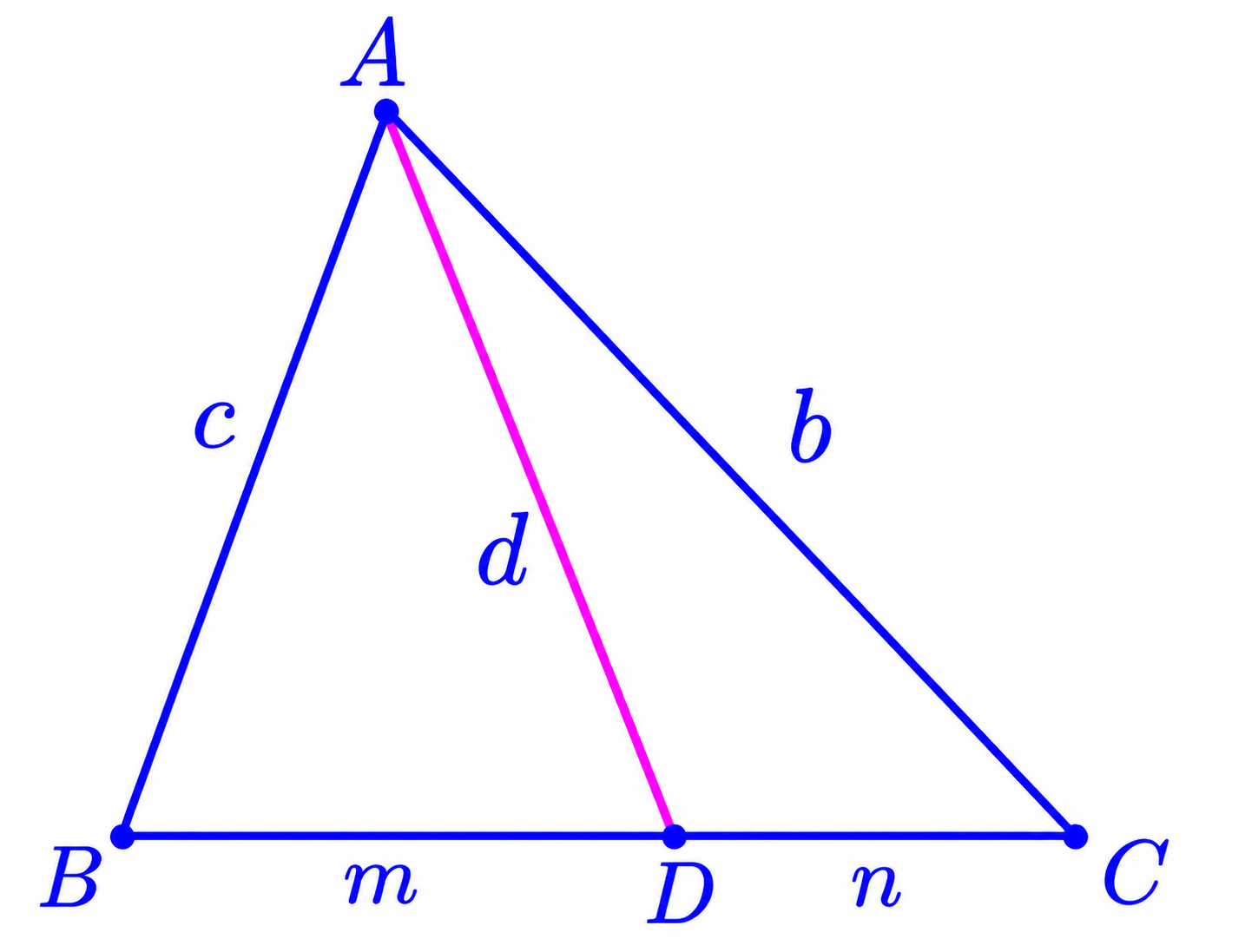
    Stewart's Theorem in triangle ABC, where AD = d, BD = m, DC = n, AB = c, and AC = b.
    a(d2+mn)=mb2+nc2\boxed{a(d^2+mn)=mb^2+nc^2}
  5. 155.

    The incenter is the intersection of the three internal angle bisectors of a triangle.
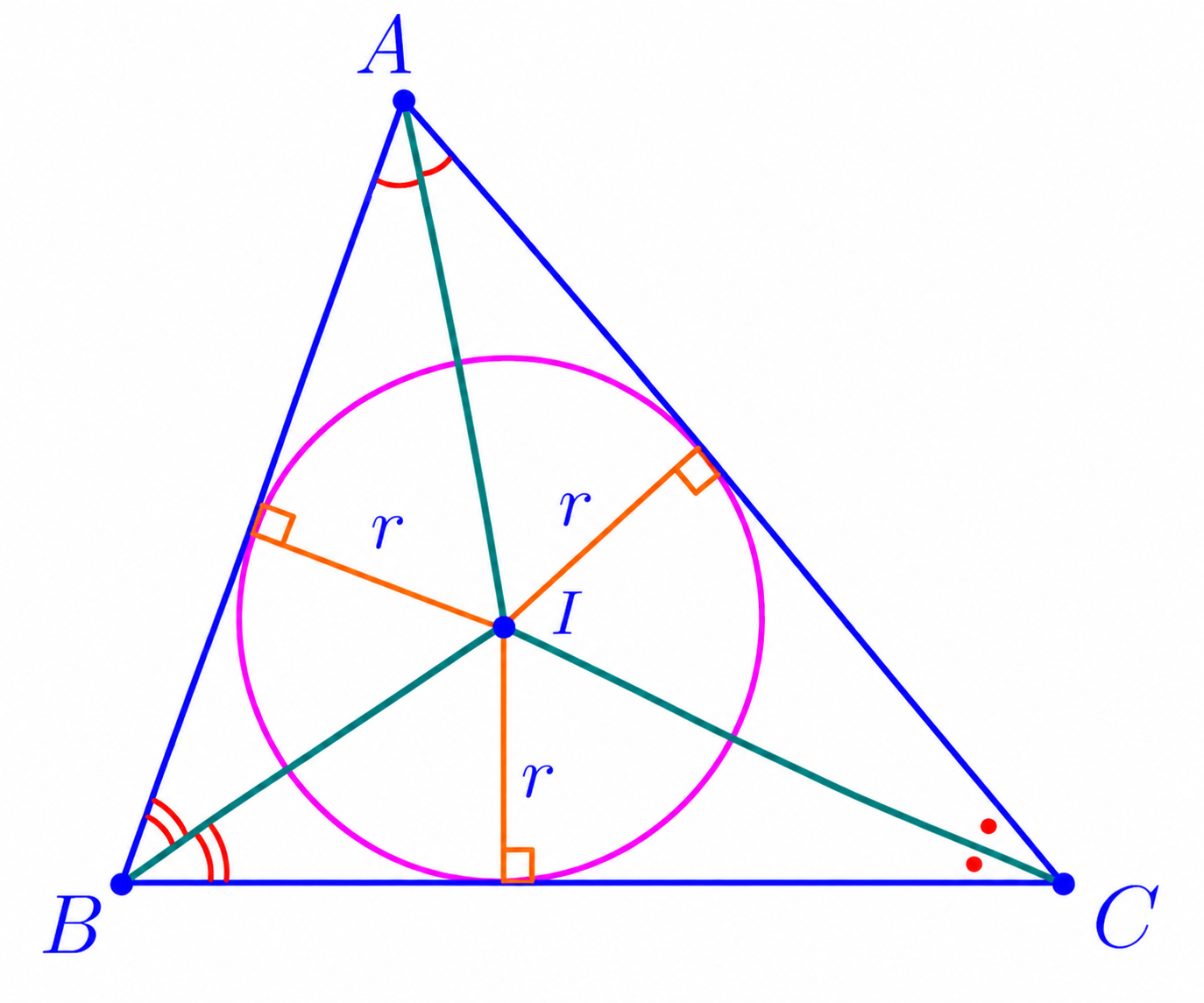
    Triangle ABC with incenter I and its incircle of radius r.
    r=[ABC]s\boxed{r=\frac{[ABC]}{s}}
  6. 156.
    π=3.14159…\pi=3.14159\ldots
    2=1.41421…\sqrt{2}=1.41421\ldots
    3=1.73205…\sqrt{3}=1.73205\ldots
    e=2.71828…e=2.71828\ldots