Rotation in Coordinate Geometry
Lesson · Advanced
Geometry: Coordinate Geometry
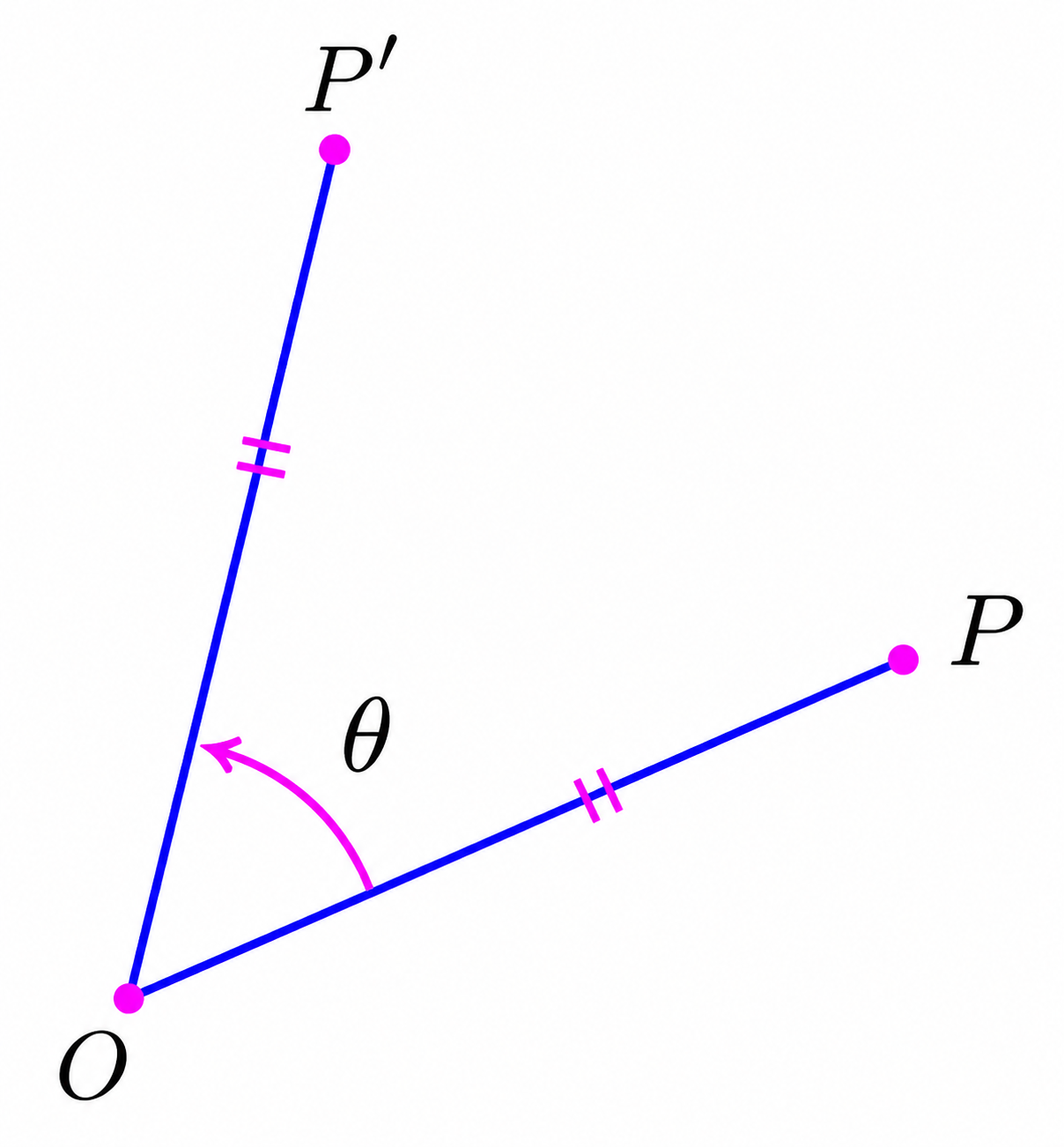
A rotation is determined by:
• a center of rotation O
• an angle of rotation θ
The angle between the corresponding segments AB and A′B′ is equal to the angle of rotation
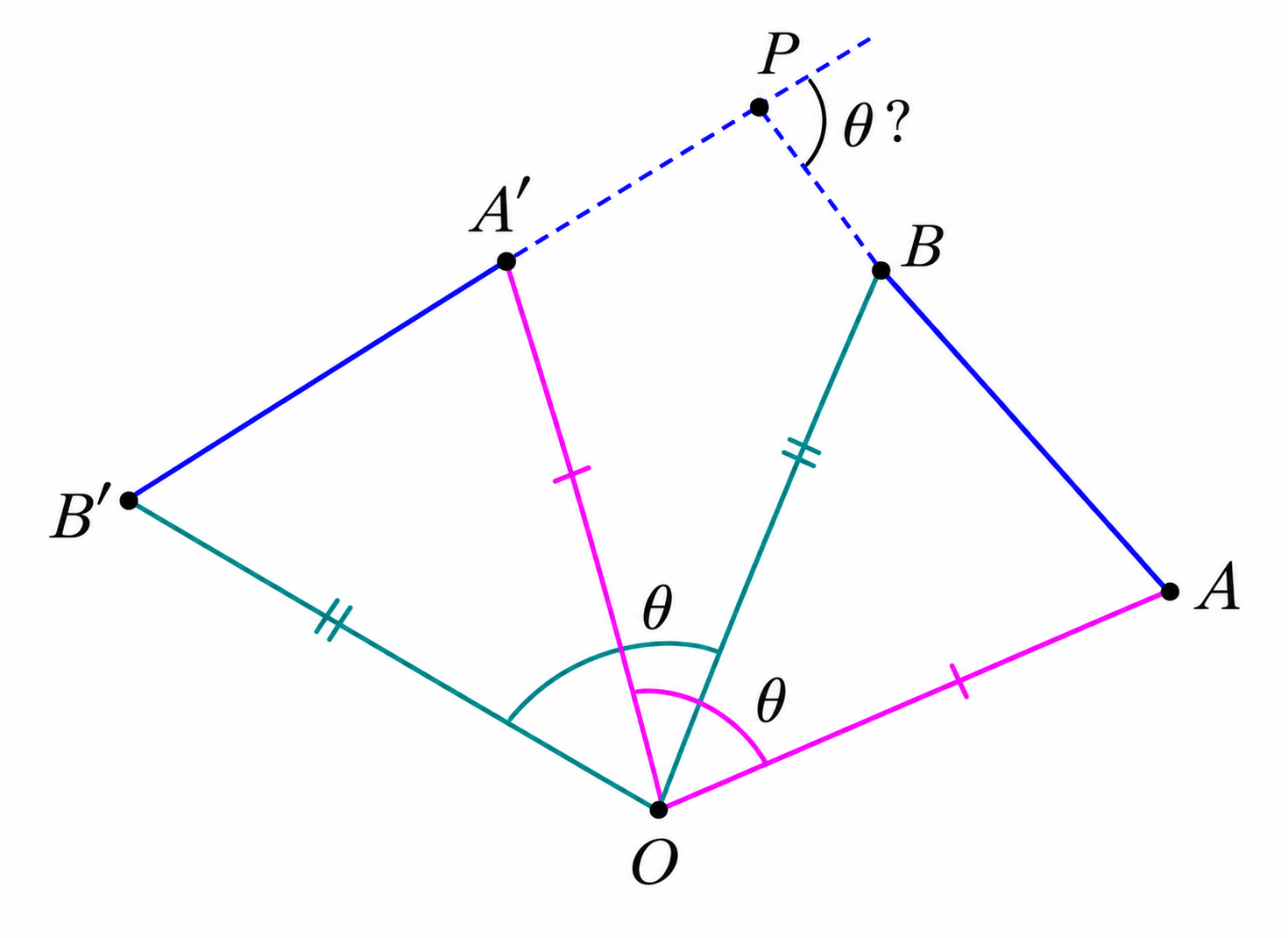
For a counterclockwise rotation by θ about the origin,
In matrix form,
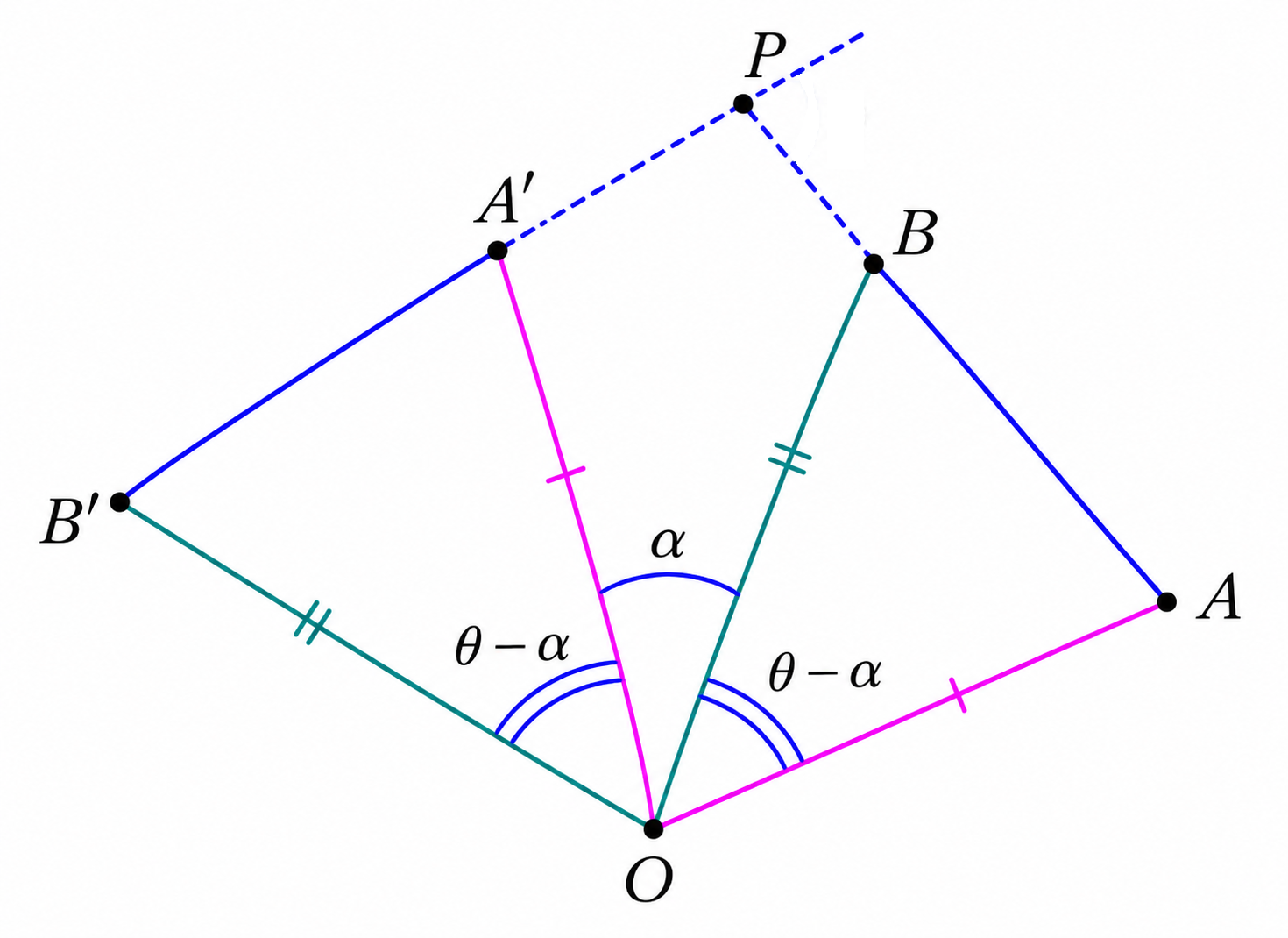
By SAS,
So
Therefore PBOB′ is cyclic
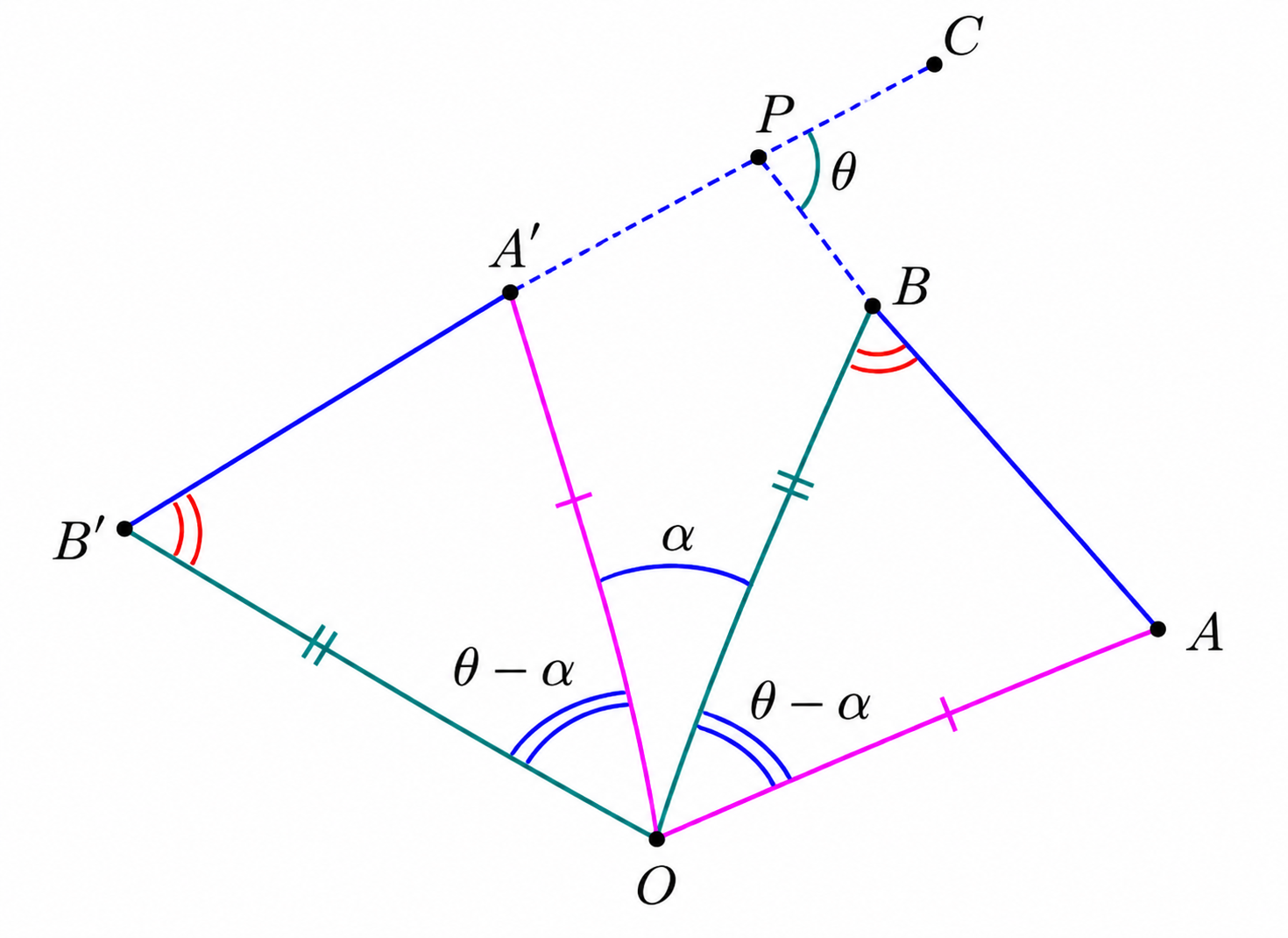
Let
Write the vector OP as
After a counterclockwise rotation by θ, the horizontal unit vector
becomes
while the vertical unit vector
becomes
Since
its rotated image is
Therefore
Suppose the center of rotation is
The easiest way to remember the formula is:
Translate → Rotate → Translate Back
First translate O to the origin:
Then rotate:
If P rotates to P′ about O, then
and
Rotations also preserve:
• distances
• angles
• areas
• collinearity
• parallelism
• orientation
So the original figure and its rotated image are congruent
90° Counterclockwise
90° Clockwise
180°
Rotate the point P=(3,5) by 90° counterclockwise about the origin
Using
we get
The point P=(4,-2) is rotated 60° counterclockwise about the origin. Find P′
and
Therefore
A 90° counterclockwise rotation sends
to
Find the center of rotation
Let the center be
Relative to O,
A 90° counterclockwise rotation sends this to
Therefore
so
Thus
Therefore
so the center is
A 60° counterclockwise rotation sends
to
Find the center of rotation
Let the center be
Then
and after a 60° rotation,
So
Solving gives
A point P′ is the image of P under a 135° counterclockwise rotation about
If
find P
To reverse the rotation, rotate P′ by
about the same center
First,
Using
we get
and
Therefore